Overview
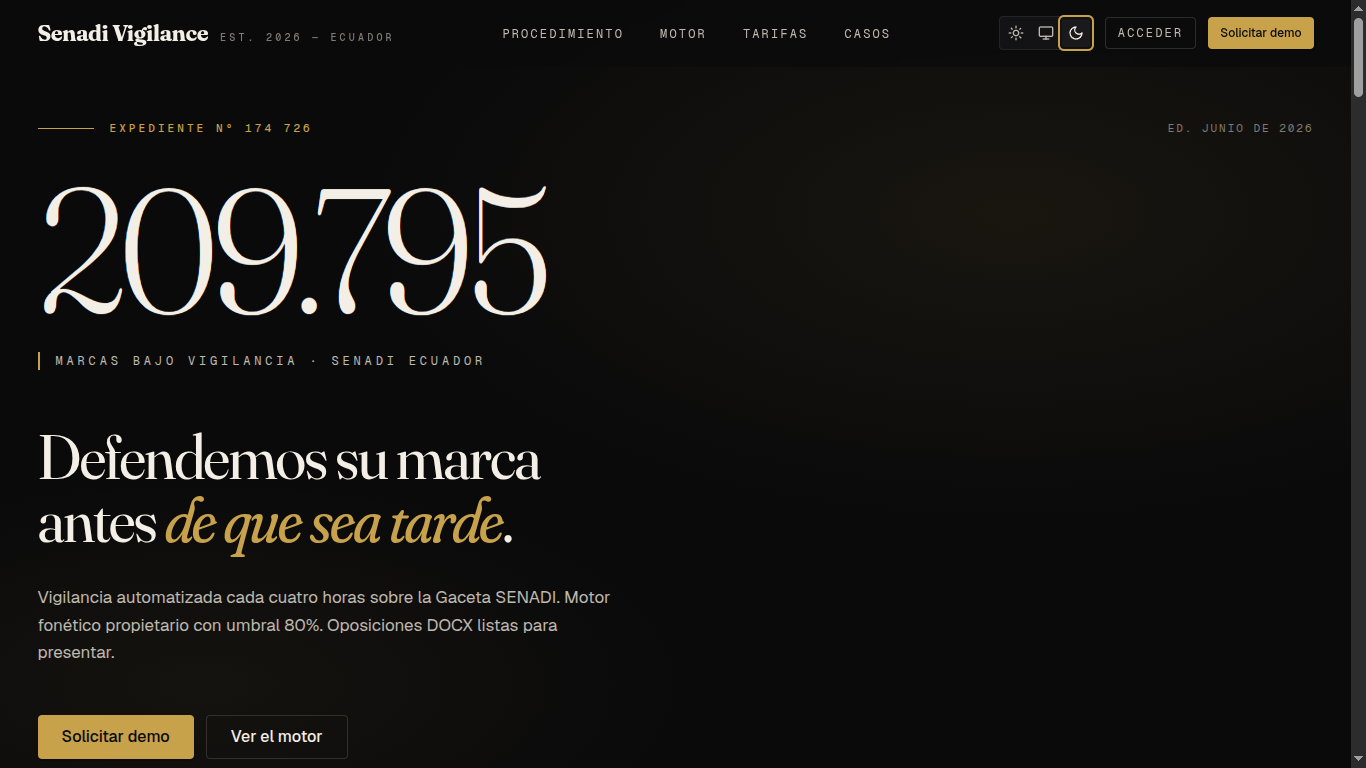
SENADI Trademark Watch is a legal-tech SaaS for Ecuador that monitors the 174k+ trademarks in SENADI’s public registry on behalf of law firms. Every new Gaceta de la Propiedad Intelectual is scraped, parsed, and compared against each client’s portfolio through a phonetic matching engine — surfacing potential conflicts and generating formal opposition documents automatically.
Shipped PocketBase-style: a Next.js 15 UI is statically exported and embedded into a single Go binary that also serves the API and runs database migrations. One artifact ships everything.
How It Works
The product runs as three stages over SENADI’s public data:
- Ingestion: A scheduled job (every 4 hours) scrapes the latest gazette and parses each published trademark — INID-coded fields, two-column OCR de-interleaved — into a global, read-mostly catalog. The cover’s publication date drives the legal-deadline estimates.
- Vigilance: Each law firm tracks a portfolio of client marks. When a new gazette lands, a phonetic engine (Metaphone + Jaro-Winkler + heuristics) compares every tracked mark against the freshly-published ones; matches above the threshold become alerts.
- Action: An alert can escalate to a formal opposition — the DOCX is rendered in the browser from embedded templates and emailed with the attachment.
Key Features
- Automated gazette ingestion: Scheduled scraping and parsing of SENADI publications, with legal-deadline estimation
- Phonetic matching engine: Proprietary similarity scoring (Metaphone + Jaro-Winkler) at an 80% threshold
- Opposition generation: Browser-rendered DOCX from embedded templates, delivered by email
- Multi-tenant from day one: Every per-tenant table is protected by PostgreSQL Row-Level Security, so one firm can never see another’s data
- Single-binary deployment: Embedded UI, no Node in production, no separate host
Technologies Used
- Backend: Go 1.26 · Gin · GORM · PostgreSQL
- Frontend: Next.js 15 (static export) · React 19 · Tailwind v4, embedded via
//go:embed - Migrations:
goose(versioned SQL, no AutoMigrate) - Scheduler:
gocronin-process, advisory-locked - API: OpenAPI-first with codegen on both sides (
oapi-codegen+openapi-typescript) - DOCX:
docxtemplaterin the browser · Email: Resend / Mailpit - Observability: OpenTelemetry → OpenObserve
Architecture
The backend is a modular monolith — one Go package per bounded context (auth, catalog, ingestion, vigilance, opposition, documents, inbox, billing, reports), models kept private and cross-context calls made through interfaces. Compiler-enforced boundaries (depguard) keep a clean path toward microservices without the upfront cost.
Design Decisions
- Single binary (PocketBase-style): UI embedded; no Node in prod, no separate host
- Multi-tenancy via RLS: isolation enforced at the database — every per-tenant query runs in a tenant-bound transaction, never as a superuser
- Versioned migrations, no AutoMigrate: the binary refuses to start against an un-migrated schema
- OpenAPI-first: the spec is the source of truth; Go stubs and the TS client are generated, so drift fails the build
Live
The product is live at senadi-prod-production.up.railway.app. The source is a private, proprietary repository.